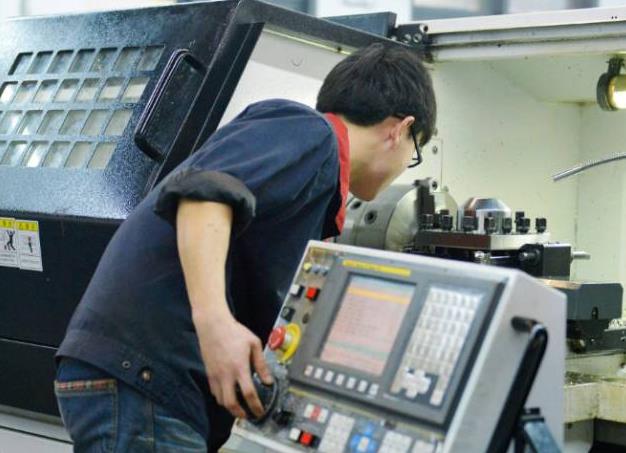
This requires 1-2 years of learning, and the operation requires a delicate touch. Beginners, especially college students, understand how to do it in their hearts, but their hands just don't work. In this process, it is necessary to learn: the operation mode of the system, the installation of fixtures, the alignment of part benchmarks, tool alignment, setting zero offset, setting tool length compensation, radius compensation, the installation and removal of tools and tool holders, tool grinding, and measurement of parts (proficient in using vernier calipers, dial gauges, dial indicators, and inner diameter lever gauges).
The horizontal machining center and large gantry (moving beam, top beam) machining center are the most indicative of operational level. The practice of operation requires comprehension! Sometimes there is a kind of artistic conception of 'leisurely heart knows, wonderful things are difficult to tell you'! In the CNC workshop, just calm down and practice hard!
Generally speaking, the process from machining the first part to achieving qualified machining accuracy requires the CNC programming technician to personally complete it. You cannot pass this level if you are not proficient in operating the machine tool. You can draw nutrition from the books in the Golden Powder Mall.
The fourth step is to have a good foundation in fixtures and measuring technology
I have listed tooling fixtures and measurement techniques separately here because they play an equally important role in the quality of parts processing as machine tool accuracy, and are one of the indicators of the level of process personnel. The entire process system: The precision of the machine tool is guaranteed by the machine tool manufacturer, and the cutting tools and cutting parameters are provided by the tool supplier. Generally, the problems are not significant, except for the fixtures and jigs that are specially designed by the process personnel for specific parts. Most parts on CNC machine tools have certain difficulties, so unpredictable problems often occur. I have been engaged in cutting and debugging parts for CNC machine tool users for 10 years, and I have never encountered fixtures that do not need to be rectified.
During debugging, more than half of the reasons for the unqualified processing of the first part are due to unreasonable positioning, clamping points, and clamping force of the fixture. The difficulty in analyzing the reasons for fixtures lies in their qualitative nature, which is difficult to quantify. If you have no experience in fixture design and component clamping, the difficulty will be great. It is recommended to seek advice from senior technicians who specialize in precision coordinate boring machines for learning in this area.
One of the fundamental skills in machining is the ability to accurately measure levels, which requires proficiency in using vernier calipers, calipers, dial gauges, dial gauges, inner diameter lever gauges, calipers, etc. Sometimes in parts processing, a coordinate measuring instrument cannot be relied upon. It must be measured manually. Imagine, if the parts are not accurately measured, which leader or worker would trust you? Practicing measurement techniques can take a long time!
 العربية
 简体中文
简体中文 Nederlands
 English
 Français
 Deutsch
 Italiano
 日本語
日本語 한국어
한국어 Português
 Русский
 Español