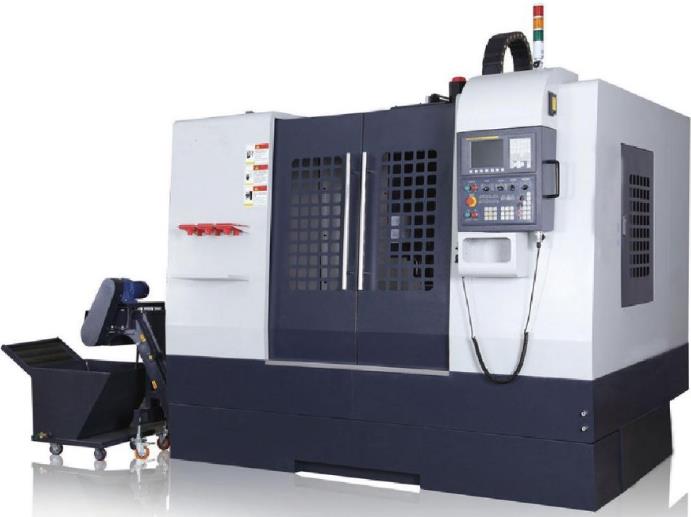
With the rapid development of industries such as automobiles, national defense, aviation, and aerospace, as well as the application of new materials such as aluminum alloys, the demand for high-speed CNC machine tool processing is becoming increasingly high.
(1) Spindle speed: The machine tool adopts an electric spindle (built-in spindle motor), with a maximum spindle speed of 200000 r/min;
(2) Feed rate: At a resolution of 0.01 μ m, the maximum feed rate reaches 240m/min and precise machining of complex surfaces can be achieved;
(3) Computing speed: The rapid development of microprocessors has provided a guarantee for the development of CNC systems towards high speed and precision. CPUs have been developed to 32-bit and 64 bit CNC systems, with frequencies increased to several hundred megahertz and even gigahertz. Due to the significant increase in computational speed, feed rates of up to 24-240m/min can still be achieved at resolutions of 0.1 μ m and 0.01 μ m;
(4) Tool change speed: Currently, the tool exchange time for advanced machining centers abroad is generally around 1 second, with some reaching as high as 0.5 seconds. Chiron, a German company, designs the tool magazine in a basket style, with the spindle as the axis and the tools arranged in the circumference. The tool to tool change time is only 0.9 seconds.
 العربية
 简体中文
简体中文 Nederlands
 English
 Français
 Deutsch
 Italiano
 日本語
日本語 한국어
한국어 Português
 Русский
 Español