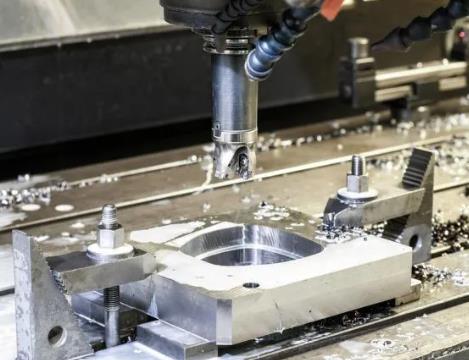
There are mainly the following aspects.
1. Strong adaptability to modified processing objects. When using CNC machine tools for modified parts, only program reprogramming is required to achieve machining. Unlike traditional machine tools, it eliminates the need for manufacturing, replacing numerous tools, fixtures, and inspection devices, as well as machine tool readjustment. Consequently, during CNC machine tool overhauls, rapid transitions between processing different parts can be achieved, providing significant convenience for single-piece, small-batch production, and trial manufacturing of new products. This not only shortens equipment adjustment and production preparation cycles but also saves substantial costs on process equipment.
2. High machining accuracy. CNC machine tools operate by receiving instructions in digital form. Currently, the pulse equivalent (i.e., the corresponding movement of the machine tool's moving parts per pulse output) of CNC devices generally reaches 0.001 mm, and backlash in the feed transmission chain as well as lead screw pitch errors can be compensated by the CNC device. As a result, CNC machine tools achieve relatively high machining accuracy and quality stability. This is determined by the structural design of CNC machine tools, which incorporates necessary measures and features the integration of mechanical and electrical systems. Firstly, structural elements such as ball screw nut mechanisms and various backlash elimination structures are introduced to minimize mechanical transmission errors. Secondly, software precision compensation technology is employed to further reduce mechanical errors. Thirdly, program-controlled machining minimizes the impact of human factors on machining accuracy. Suzhou Weixingli Electromechanical Equipment Trading Co., Ltd. explains that these measures not only ensure high machining accuracy but also maintain high quality stability.
 العربية
 简体中文
 Nederlands
 English
 Français
 Deutsch
 Italiano
 日本語
 한국어
 Português
 Русский
 Español